
A Deep Dive Into the Art of Log Joinery
The finished corner of a log home may look simple. Getting it to fit that way is not. Good log joinery comes from understanding the wood, reading each log, and taking the time to make one irregular piece of timber fit another the way it should.
The Big Idea
In a handcrafted log home, the logs are not just decoration. They are the wall, the structure, and much of what gives the home its character. The quality of the joinery affects how those logs bear on one another, how the wall settles, how well the building sheds weather, and how the finished home feels years after the crew has left.
What Log Joinery Really Is
At its simplest, log joinery is the way one log fits into another.
The simple definition leaves out most of the work.
A handcrafted log is not a factory-made board. It is not perfectly straight, perfectly round, or identical to the one beside it. One log may carry a little sweep. Another may taper more heavily from butt to top. Another may have a knot, twist, or natural change in shape that affects where it belongs in the wall.
You do not get good results by pretending those differences are not there. You get good results by learning how to work with them.
A good log builder is not trying to make every log identical. He is trying to understand what each log gives him and put it where it works best.
That is one of the biggest differences between handcrafted log construction and a system built from uniformly processed material. The carpenter has to make decisions constantly. Which face should turn inward? Which end should carry the corner? How does this log sit on the course below? Where does the natural shape help the building, and where does it need to be corrected?
The joint is where all of those decisions finally meet.
The Swedish Cope Method We Build With
At Caribou Log Homes, our handcrafted homes use Swedish cope construction, often described as full-scribe construction.
Instead of machining every log to a standard profile and stacking them together, the upper log is fitted to the natural contour of the log beneath it. The craftsman studies that relationship, scribes the profile, removes the material that needs to come out, and works the fit until the two logs seat together properly.
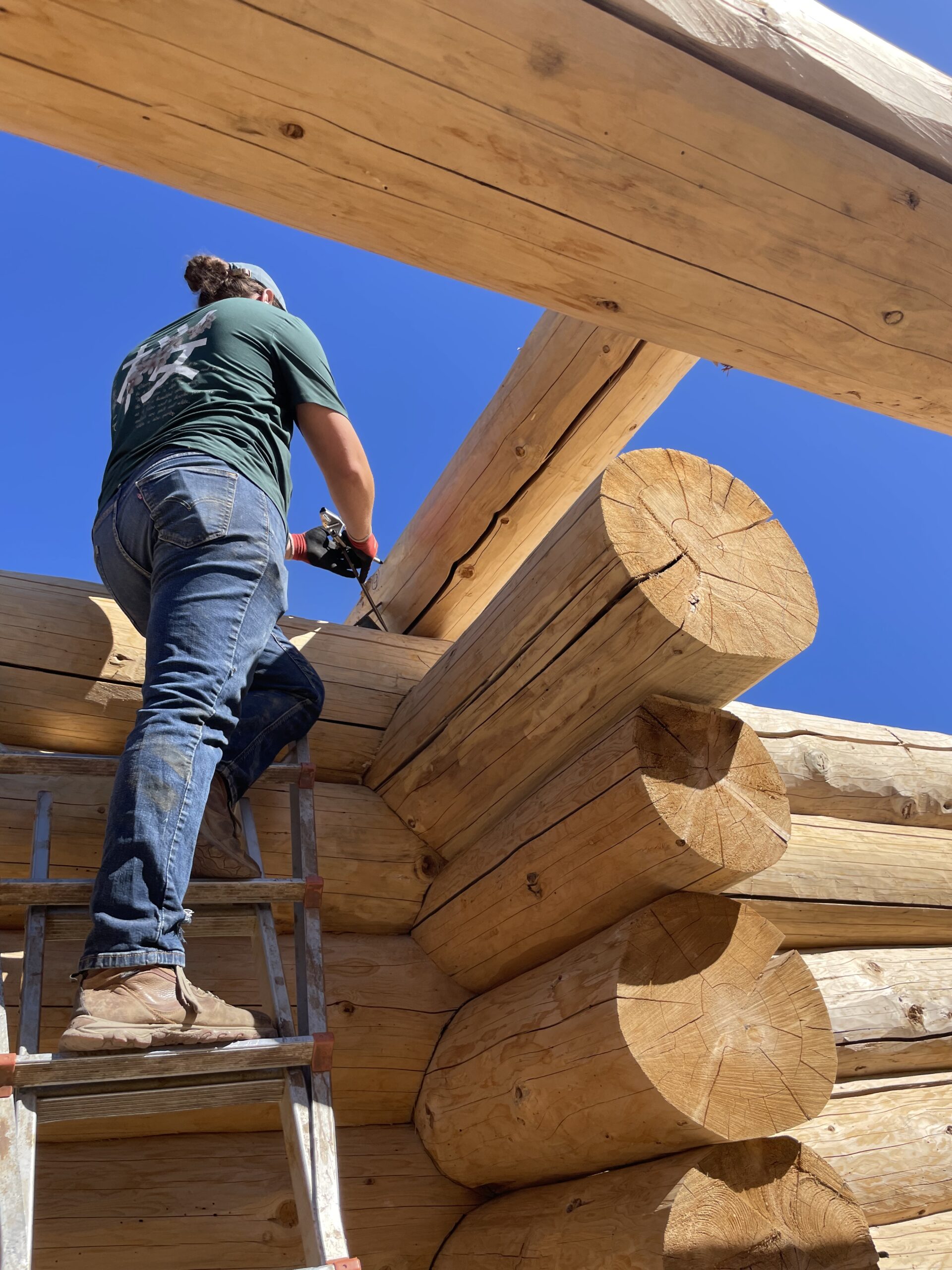
At the corners, the same principle carries into the notch work. The corner has to do more than look impressive. It needs to hold the courses together and fit into the overall wall system correctly.
The Long Groove
The cope running along the length of the log allows one irregular natural surface to fit the irregular natural surface below it. That fit is created for those two particular logs. Swap one of them out, and the work changes.
The Corner Notch
The corner is one of the places where a builder's experience becomes easy to see. A properly worked notch has to account for fit, bearing, the natural shape of the logs, and the way the wall will behave as the structure settles.
Scribing Is Where the Handcrafting Becomes Obvious
From a distance, people see a wall of logs.
Standing beside the crew, you see something very different.
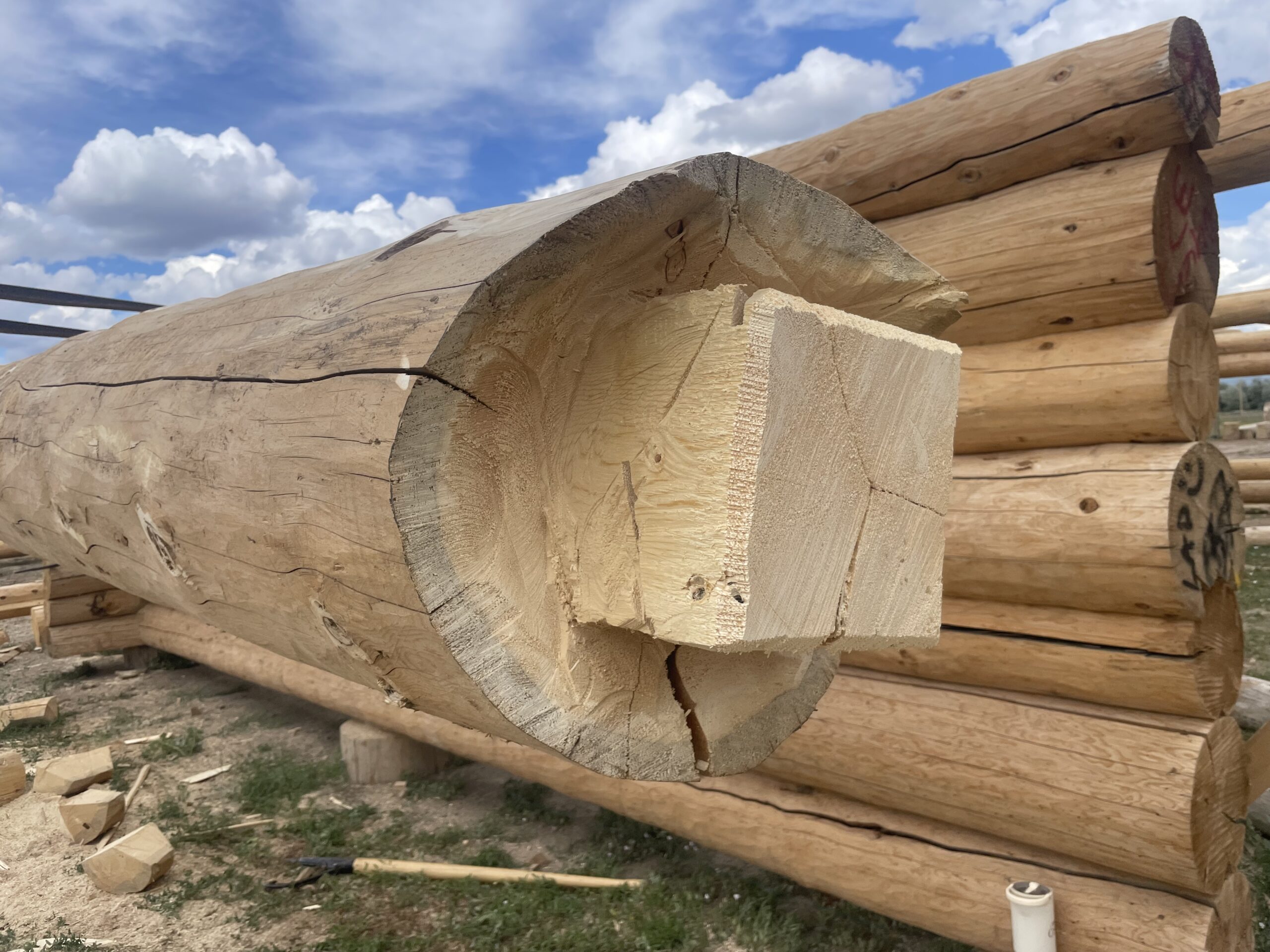
A log is placed above the course below it. Its position is checked. The relationship between the two logs is marked. The log comes back down. Material is cut away. Then it goes back into place and the fit is checked again.
Sometimes the first cut gets you close. Close is not the same thing as finished.
Small high spots matter. The way the log bears matters. The notch matters. A craftsman may remove a surprisingly small amount of wood, set the log again, and find that the whole piece now sits differently.
This is why handcrafted log building cannot be reduced to “cutting notches.” The cut is only part of the work. Knowing what to cut, what not to cut, and when the fit is right comes from experience.
Modern tools help us make that work faster and more accurately than builders could generations ago. Chainsaws, layout tools, lifting equipment, and better measuring equipment all have a place.
They still do not make the decision for the person holding them.
Every Log Changes the Next Decision
One of the easiest mistakes to make when looking at a log home is assuming the walls are simply a stack of interchangeable pieces.
They are not.
Every course changes what comes after it. A little sweep in one log may influence the way the next log is rotated. A heavy taper may make one position better than another. A strong natural feature may become something we want to expose instead of hide.
That is part of what gives a handcrafted house its character, but it is also part of what makes the work demanding.
You are building with a natural material that has already spent decades growing into the shape it has. The job is not to erase all of that history. The job is to turn it into a sound building.
We primarily work with dead-standing timber when it is appropriate for the project. Even after careful selection, those logs still carry their own taper, shape, knots, and character. That individuality is part of the material, and it has to be accounted for in the craftsmanship.
Why the Fit Matters After the House Is Finished
Joinery is beautiful when it is done well, but appearance is not the reason we spend so much time on it.
These joints are part of the building envelope.
The logs have to work together as the home goes through heat, cold, dry weather, moisture, and the normal movement that comes with a massive wood structure. Openings for windows and doors have to be planned with that movement in mind. Corners have to stay sound. The wall system has to be detailed so water has fewer opportunities to become a problem.
Good joinery does not eliminate the need for proper design, roof overhangs, drainage, flashing, sealants, maintenance, or the other details that protect a log home.
It gives all of those details a better structure to work with.
Water management starts with design, not with a bucket of stain. A well-built log home has to be thought through from the roofline to the lowest course of logs.
That is also why we tell buyers not to judge a builder solely from photographs of finished homes. The prettiest part of the project is not always the part that tells you the most.
If You Want to Judge the Craftsmanship, Look at a Home While It Is Being Built
Finished houses are useful. Active jobs can tell you more.
When the walls are still going up, the work has nowhere to hide.
- Look at how consistently the logs bear on one another.
- Look closely at the corner notches instead of only standing back for the overall view.
- Look at the cuts around future doors and windows.
- Look at how the crew handles irregular logs instead of avoiding them.
- Look at the general organization and care being taken with the material.
- Ask the builder why a particular log or joint was handled the way it was.
An experienced log builder should be able to explain those decisions without turning the conversation into a sales pitch.
There should be a reason behind what you are looking at.
Corner Work Tells You a Lot About the Builder
People naturally notice the corners of a log home because that is where the structure looks most different from conventional construction.
Builders notice them for another reason.
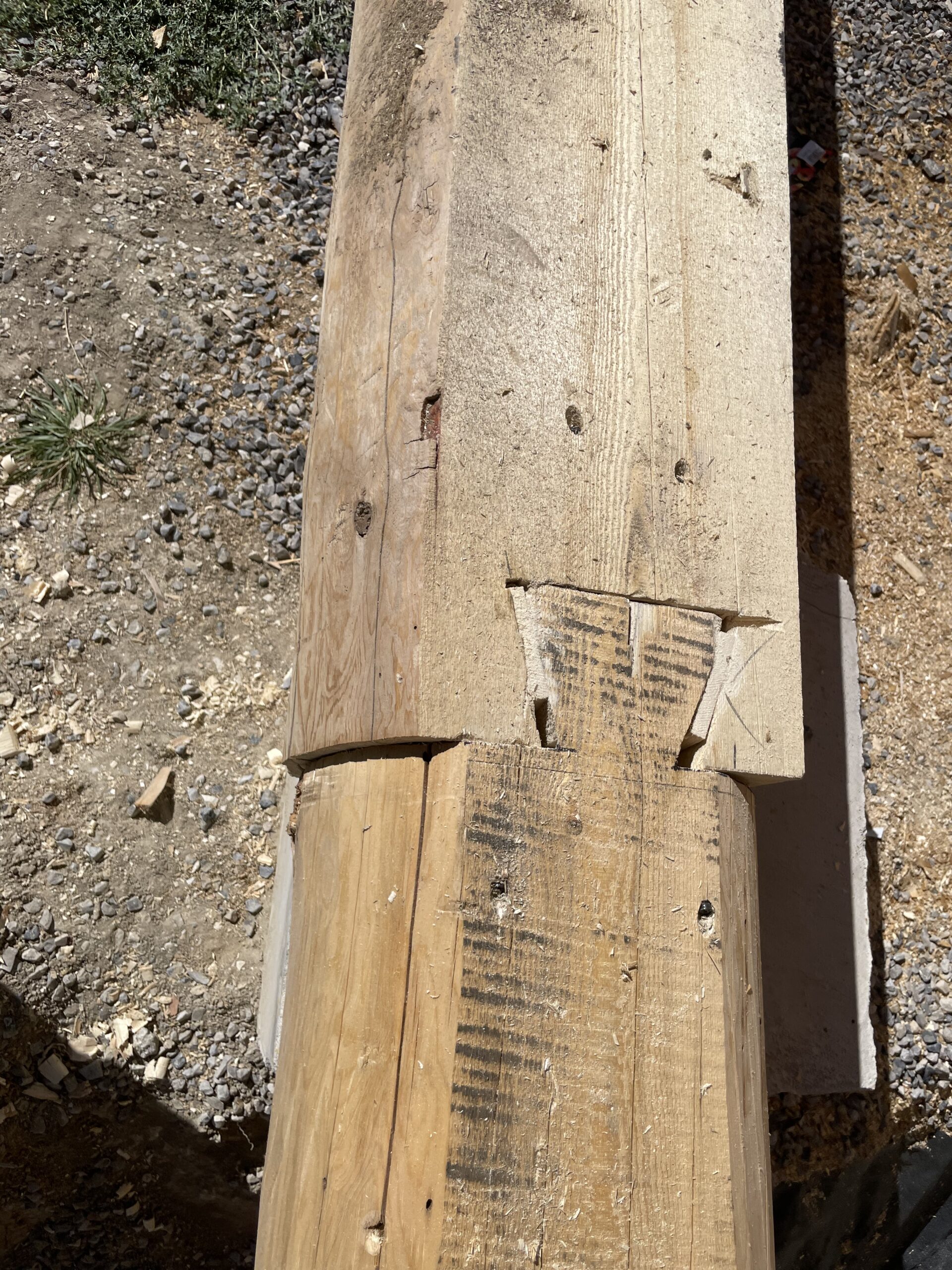
A corner brings several problems together at once. Logs coming from different directions have to meet. Notches need to carry properly. The courses need to remain consistent. The finished intersection has to work structurally while still looking intentional.
You can learn a lot about a crew by watching how much attention they give that work.
When a notch is close but not right, an experienced craftsman does not try to force it into submission. He finds the high spot, corrects it, checks the bearing again, and keeps working until the joint does what it is supposed to do.
Craftsmanship Is Not the Same Thing as Making Everything Perfectly Uniform
A handcrafted log home should be precise where precision matters.
That does not mean every natural feature needs to disappear.
Knots, taper, changes in diameter, checks, and variations in the surface are part of building with real logs. The goal is not to make a handcrafted wall look like it came out of a molding machine.
The goal is to make the natural material work together well.
There is a difference between character and careless workmanship.
A natural curve can be beautiful. A poorly fitted joint is still a poorly fitted joint. One is part of the timber. The other is a construction decision.
Knowing the difference is part of the craft.
What Buyers Should Ask About Log Joinery
You do not have to become a log builder before hiring one.
You should know enough to have a useful conversation.
What construction method do you use?
Ask whether the home is handcrafted, milled, full-scribe, post-and-beam, hybrid, or another system. These are not interchangeable ways of building.
Who actually does the log work?
Find out whether the company you are hiring performs the craftsmanship itself or simply supplies a package that another crew assembles.
How do you account for settling?
The builder should be able to explain how movement is considered at windows, doors, posts, partitions, and other places where log walls meet components that behave differently.
Can I see a project under construction?
An active job gives you a much better view of fit, notch work, material handling, and day-to-day craftsmanship than finished photography alone.
We go deeper into those kinds of questions in our guide to choosing a log home builder . That article is a good next read if you are actively comparing companies.
The Best Joinery Usually Does Not Call Attention to Itself
A well-fitted handcrafted wall has a certain quietness to it.
The logs look like they belong together.
You do not walk into the room wondering how a gap was covered or how a corner was forced into place. The work feels natural because the builder spent the time making the pieces cooperate before the home was finished.
Most homeowners will never know how many times a particular log was set, marked, cut, adjusted, and checked.
They should not have to.
The homeowner gets to enjoy the finished room. The craftsman has to remember everything that went into making that room feel right.
Why We Still Build This Way
There are faster ways to produce something that looks like a log home.
That is not what we are trying to build.
We build handcrafted homes because the process lets us work with the timber instead of reducing every piece to the same manufactured profile. It lets the character of the logs remain part of the house while still demanding a high level of precision from the crew.
It also means no two projects are ever exactly the same.
The land changes. The design changes. The logs change. The people building the home have to respond to all three.
That is what makes this kind of work interesting after years of doing it.
And it is why, when we walk through a finished log home, we still find ourselves looking at the corners.
See the Craftsmanship Before You Choose the Builder
If you are planning a handcrafted log home, learn how the home will actually be built, not just what the finished rendering looks like. Explore our floor plans, learn about our building process, or start a conversation about your property and the kind of home you want to create.